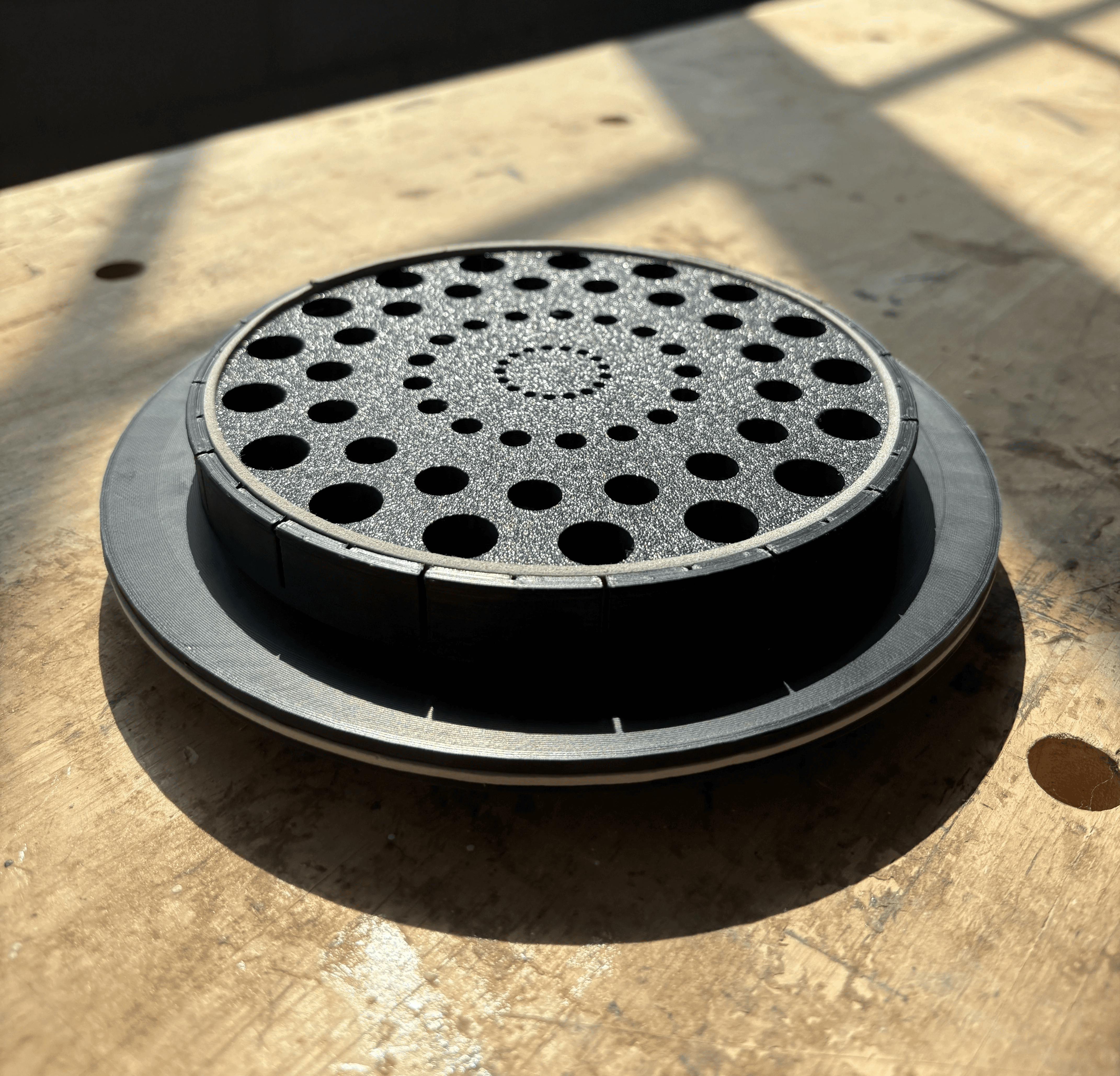
Volumetric
Exploration into alternative and sustainable bass traps using damaged speakers and 3D printed inserts
Introduction
The final object is the evolution of an experiment into variable Helmholtz resonance. A 3d printed arrangement of inserts are used to retrofit a pair of worn bookshelf loudspeakers into a functional set of bass traps.
Helmholtz Resonance
A Helmholtz resonator addresses modal pressure buildup at a specific low-frequency band, reducing narrow-band resonance amplitude and decay time. The classic example is a beer bottle; blow across the top of the bottle and it creates a specific tone, which can be calculated.
Development
The perforation strategy begins with a phyllotaxis arrangement, establishing a natural, mathematically efficient distribution of openings. Each successive layer extends its neck length in a stepped sequence reminiscent of muqarnas, producing a form that is both highly optimized and intentionally dynamic.
The design evolved through iterative studies inspired by mechanisms like watch movements and everyday objects such as charcoal grill lids. Ultimately, the final geometry emerged from distilling the object’s two essential requirements - variability and apertures - into a formal system.